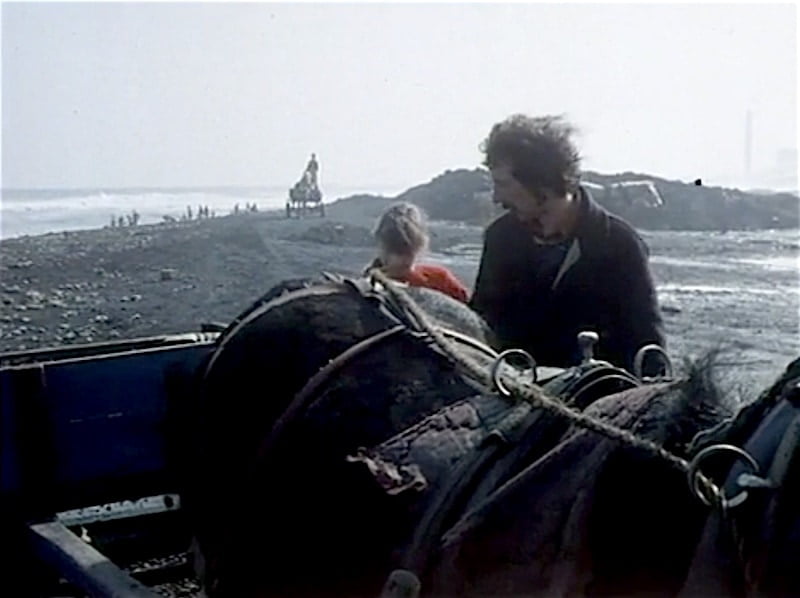
Seacoal (1985)
Amber Films (Producer)
82 mins, 16mm
Colour/optical
Feature film
Available as DVD and VHS
Marks & Spencer Award, Tyneside, 1985
European Film Award, Munich, 1986
Betty and her daughter Corinna are introduced to the harsh seacoaling way of life by Ray, an ex-seacoaler returning from a job with ICI. His offer of a caravan on a cliff top and promises of the Klondyke that awaits them at least seem preferable to the violent marriage she has left behind. The film sets Betty's struggle for survival against the wider struggles of the seacoaling community, surviving on the fringes of capitalism. Despite the exploitation by a local entrepreneur, run-ins with dole snoops and School Board men and the ever encroaching regulations of a hostile council, their lives retain a kind of anarchic romance, which is reflected in the film's lyrical style.
The inspiration for Seacoal undoubtedly came from the staggering visual location in which it is filmed; the industrial landscape of power station and pit framing the blackened beach of Lynemouth where, for generations, local people and travellers have made their living from collecting waste coal washed ashore. Channel 4 wanted a feature film and Amber suggested this territory. A small commission for the Ashington photographer Mik Critchlow in the early 1980s had, in consequence, opened access to the seacoaling community at Lynemouth, where one of Mik’s cousins, Trevor Critchlow, worked. The bleak energy of its raw capitalism had often attracted photographers, Chris Killip among them. The caravan Amber bought on the site housed Chris as he developed his photography project, Seacoal (1984), with its stark images of life at the margins. When he moved out, the Amber crew moved in, making a feature film of the same name, which was released the following year.
Seacoal, Amber’s first feature film represented a major step forward in its experimental mixing of drama and real life. The production team lived with the seacoalers on and off for two years, and the daily events of the camp were incorporated into the film as straight documentary, improvised sketches or fully dramatised reconstructions. Equity, the actors union, granted Amber special concessions to work with the seacoalers themselves on the condition that they did not script for, or direct them. Amber were unable to predict responses to the actors’ lines, which meant that the scripting had to be done piecemeal as the plot developed. The technique paid off, however, in terms of the film's spontaneity.
After screening on Channel Four, Sean Day Lewis, from the Daily Telegraph, while devoting most of his TV Choice column to this ‘haunting unsung film’, nevertheless expressed surprise that this was in spite of it being made by Amber Films, ‘a co-operative too devoted to equality to acknowledge the existence of a director or cameraman.’
AMBER FILMS
Made under the auspices of the ACTT Workshop Declaration with financial assistance from Northern Arts and Channel Four Television.
Cast includes: Ray Stubbs, Amber Styles, Brian Hogg, Sammy Johnson, Benny Graham, The Laidler Family, Trevor Critchlow, Val Waciak, Gordon Tait, John Cook, Stan Robinson.
Screenplay by Tom Hadaway
REVIEWS
The European prize... went this year to a British film Seacoal, by unanimous vote of the international jury. The award is all the more gratifying as recognition of the film workshop movement which flourishes in this country. Even though the group insists there is no dominant creative individual there is evidently a real film genius at work here. The film triumphantly demonstrates that the more specific, local instance can often provide the most significant illumination of the human predicament. David Robinson, The Times
As haunting visually as it is heroic politically... Seacoal celebrates more than nostalgia for a lost way of life. Despite the poverty, the weather, the uncertainty of the living, the conspiracies of the dole queue, anti-Romany racism and the fear of the caravan fires and ghosts on the beach; this reconstruction of lives lived takes on epic proportions. Amber have escaped their anthropological style to become something new and startling on the British scene. Sean Cubitt, City Limits
Gritty Loach style realism, leavened by lyrical camerawork and a strong romantic sense of community... intelligent and sensitive, but be warned the dialect and accents are sometimes impenetrable. Geoff Andrew, Time Out
Seacoal... might be classified , in television terms, as a docu-drama. But the resonances here are all cinematic. The film's soundtrack calls to mind the treatment of working-class lives in certain American genres, (sagas of the dustbowl for instance)... What emerges is a style and an address that has more in common with neo-realism... With unfailingly persuasive performances from its leads, Seacoal is a notable achievement of quite unflinching conviction. Verina Glaessner, Monthly Film Bulletin
A haunting, unsung film... There is an extraordinary quality of gritty melancholy, with lovely camerawork... a consistent emotional truth in the acting which makes the professional players and the coalers indistinguishable from each other. Sean Day-Lewis, The Daily Telegraph
There is such a raw and vivid authenticity about Amber Film's Seacoal as to suggest a complete naturalism, that the film-makers simply turned up and pointed the camera. Ironically, it took two years living and working with the Lynemouth seacoalers before they could attain this precious lack of artifice. It's a radical piece of film-making of the highest importance. Peter Mortimer, Northern Echo
info
Add your comments
You must be a registered user to add comments. Click here to register, or log in using your account details.